The DRIVE Framework
On this page
DRIVE is the execution process for Behavioral Strategy. It provides a structured practitioner process for working toward each stage of the Four-Fit Hierarchy. Four-Fit defines what must be validated. DRIVE defines how the work is done. The method draws on behavioral research, but that research does not by itself validate DRIVE as a complete integrated method.
Four-Fit defines what must be validated. DRIVE defines how the work is done.
The relationship is simple:
- Four-Fit Hierarchy defines what must be validated at each stage
- DRIVE Framework defines how you do that validation work
Use Four-Fit to know what to validate. Use DRIVE to know how to do it.
How DRIVE Maps to Four-Fit
| DRIVE Phase | What You Do | Maps to |
|---|---|---|
| Define | Articulate goal, identify population, validate problem exists | Problem Market Fit |
| Research | Conduct behavioral research, apply the Behavior Fit Assessment, select target behavior | Behavior Market Fit |
| Integrate | Design solution that enables the validated behavior | Solution Market Fit |
| Verify | Measure behavioral KPIs in market conditions | Product Market Fit |
| Enhance | Iterate based on behavioral data | Sustaining Product Market Fit |
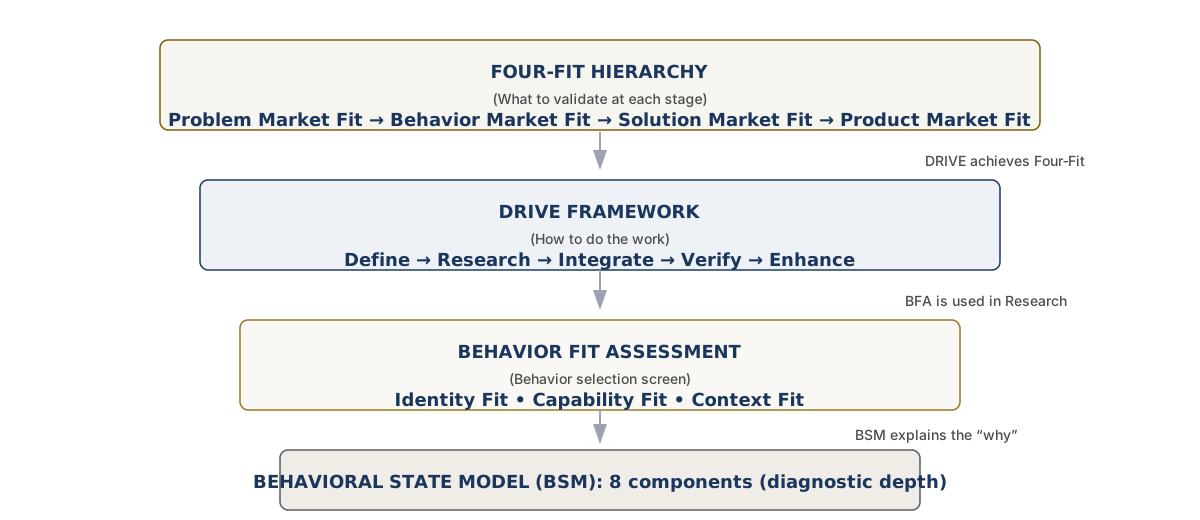
FOUR-FIT HIERARCHY              DRIVE PROCESS
(What to validate)              (How to do it)

┌─────────────────────┐         ┌─────────────────────┐
│   PROBLEM FIT       │ ◄────── │   DEFINE            │
│   Do users seek     │         │   Goal + Population  │
│   solutions?        │         │   + Problem          │
└──────────┬──────────┘         └─────────────────────┘
           │
           ▼
┌─────────────────────┐         ┌─────────────────────┐
│   BEHAVIOR FIT      │ ◄────── │   RESEARCH          │
│   Can and will      │         │   Behavior Fit      │
│   they do this?     │         │   Assessment        │
└──────────┬──────────┘         │   + Observation      │
           │                    └─────────────────────┘
           ▼
┌─────────────────────┐         ┌─────────────────────┐
│   SOLUTION FIT      │ ◄────── │   INTEGRATE         │
│   Does our solution │         │   Enable behavior   │
│   enable behavior?  │         │   through design     │
└──────────┬──────────┘         └─────────────────────┘
           │
           ▼
┌─────────────────────┐         ┌─────────────────────┐
│   PRODUCT FIT       │ ◄────── │   VERIFY + ENHANCE  │
│   Does behavior     │         │   Measure + iterate  │
│   persist at scale? │         │   continuously       │
└─────────────────────┘         └─────────────────────┘
The Five DRIVE Phases
1. DEFINE → Problem Market Fit
Goal: Establish clear strategic objectives and validate that users actively seek solutions to the identified problem.
Key activities:
- Articulate measurable strategic objectives
- Identify and validate target user segments
- Conduct problem interviews until themes converge
- Document evidence of problem-seeking behavior
- Define success metrics in behavioral terms
Exit criteria (Problem Market Fit):
- Clear, measurable strategic objectives defined
- Target user segments validated through research
- Problem-seeking behavior documented with evidence
- Themes converging across interviews
Consumer example: Imagine a photo-sharing team that defines its outcome (more people sharing photos with friends), names its population (smartphone users who already take photos), and documents evidence that this population looks for easier ways to share. The team is imaginary, not Instagram.
Example (Enterprise): Claims operations validates that policyholders experience significant pain from documentation delays and actively seek faster resolution.
2. RESEARCH → Behavior Market Fit
Goal: Identify and validate specific behaviors that the target population can and will perform to solve the validated problem.
The Behavior Fit Assessment is a practitioner decision tool for comparing candidate behaviors across Dispositional Fit, Capability Fit, and Context Fit. It is not a validated measurement instrument. Treat the minimum dimension as a bottleneck and prioritization heuristic; it is not a deterministic probability of behavior.
A score of 6 out of 10 on each Behavior Fit Assessment dimension is a starting threshold that must be calibrated by domain, population, context, stakes, and observed behavior.
Key activities:
- Conduct behavioral observation in natural contexts
- Identify multiple candidate behaviors that could solve the problem
- Apply the Behavior Fit Assessment to each candidate:
- Dispositional Fit: Does this behavior match the population’s relatively enduring tendencies and preferences?
- Capability Fit: Can they actually perform this behavior?
- Context Fit: Does the social and physical environment support this behavior?
- Use minimum ratings to identify candidate bottlenecks and prioritize candidates for real-context validation
- Validate selection through realistic testing
Exit criteria (Behavior Market Fit):
- Multiple candidate behaviors identified
- Behavior Fit Assessment completed for each candidate
- Ratings, evidence gaps, calibration choices, and candidate bottlenecks are documented
- Behavior Market Fit is supported by observation in realistic contexts
Evaluation rubric (for scoring each dimension):
| Criterion | High (8-10) | Medium (5-7) | Low (1-4) |
|---|---|---|---|
| Dispositional Fit | Draws on existing tendencies and preferences | Broadly compatible; no strong dispositional mismatch | Requires sustained action contrary to characteristic preferences or priorities |
| Capability Fit | Uses existing skills | Minor learning needed | Requires major skill change |
| Context Fit | Environment supports | Neutral environment | Environment works against |
Retrospective consumer example: In an analyst application of BFA, Instagram’s photo-sharing behavior appears stronger across the three dimensions than Burbn’s check-ins. These are explanatory ratings, not measurements made by Instagram’s team. See the Instagram case for the historical evidence and limits.
3. INTEGRATE → Solution Market Fit
Goal: Design solutions that enable and encourage the validated target behavior.
Key activities:
- Map every solution feature to a validated behavior
- Conduct friction analysis (identify and remove barriers)
- Prototype solutions that make the behavior easy and obvious
- Test with users: does the solution trigger the behavior?
- Iterate until the solution reliably enables behavior
Exit criteria (Solution Market Fit):
- Every feature maps to a validated behavior
- Friction analysis completed and addressed
- Prototype testing confirms behavior enablement
- Solution measurably reduces friction and increases payoff
Feature-to-behavior mapping example: The features below belong to an imaginary photo-sharing app. They show how to map features to behaviors.
| Feature | Enables Behavior | Friction Removed | Payoff Added |
|---|---|---|---|
| One-tap capture | Share photos | Camera launch time | Instant gratification |
| Filters | Share photos | Skill gap (bad photos) | Pride in output |
| Feed | Discover content | Search effort | Relevant content surfaces |
4. VERIFY → Product Market Fit
Goal: Confirm that the solution drives the target behavior sustainably in real market conditions.
Key activities:
- Define behavioral KPIs before launch
- Implement tracking infrastructure
- Launch to initial cohort
- Monitor behavior completion rates from day one
- Track bPMF and behavior retention cohorts
- Assess viable economics alongside sustained behavior; for programs, assess sustainable operations and funding
Key metrics:
| Metric | Definition | Target |
|---|---|---|
| bPMF | % of users completing target behavior at threshold frequency | ≥ 70% (default heuristic; document your threshold) |
| TTFB | Time to first behavior completion | Domain-specific |
| Δ-B | Change in behavior from baseline | Meaningful improvement |
| Behavior retention | % still performing behavior at D30/D180 | Threshold varies by domain |
Common verification mistakes:
- Vanity metrics focus: tracking downloads instead of behaviors
- Delayed measurement: waiting months before checking data
- Aggregate blindness: overall looks good but segments are failing
5. ENHANCE → Sustaining Product Market Fit
Goal: Continuously refine the solution based on behavioral data to maximize long-term impact.
Key activities:
- Analyze behavioral performance data weekly
- Identify underperforming segments or behaviors
- Run experiments on behavior enablement
- Iterate on the solution based on learnings
- Scale what works; fix or remove what doesn’t
Enhancement decision tree:
Current Performance
       │
       ├── Below Target
       │   └── Diagnose: Which behaviors? What barriers? Which segments?
       │       └── Actions: Reduce friction, increase motivation, improve ability
       │
       ├── At Target
       │   └── Optimize: Which behaviors drive most value? How to expand?
       │       └── Actions: Scale success, expand reach, deepen engagement
       │
       └── Above Target
           └── Sustain: What maintains performance? What risks regression?
               └── Actions: Reinforce habits, monitor threats, innovate ahead
DRIVE in Practice: Full Example
Healthcare example: Imagine an app that aims to improve medication adherence. The patients, scores, and results below are made up to show the workflow. They are not clinical evidence or treatment advice.
DEFINE (→ Problem Market Fit)
- Objective: increase medication adherence from 60% to 85%
- Population: chronic condition patients on daily medication
- Problem validation: interviews reveal patients forget doses, feel unsure medication helps, lack routine integration
- Problem Market Fit achieved: clear evidence patients seek solutions to adherence challenges
RESEARCH (→ Behavior Market Fit)
- Candidate behaviors:
- Set daily phone alarm → Dispositional 5, Capability 8, Context 7 (minimum: 5; investigate the dispositional bottleneck)
- Use smart pill bottle → Dispositional 4, Capability 6, Context 5 (minimum: 4; weaker candidate pending evidence)
- Link to existing morning routine → Dispositional 7, Capability 9, Context 8 (minimum: 7; stronger candidate for field validation)
- Weekly pill organizer prep → Dispositional 6, Capability 7, Context 7 (minimum: 6; plausible candidate for field validation)
- Selected behavior for field validation: link medication to existing morning routine. It has the highest minimum rating in this example, and the team also weighs its evidence, likely contribution to adherence, constraints, and uncertainty. The minimum rating is not an automatic ranking or viability verdict
- Behavior Market Fit achieved: behavior validated through observation; patients can and will integrate medication into existing routines
INTEGRATE (→ Solution Market Fit)
- Solution design: app identifies the patient’s existing morning routine, suggests a specific anchor (e.g., “after brushing teeth”), sends contextual reminder
- Friction removed: generic reminders replaced with routine-linked prompts
- Prototype testing: 20 patients tested; 17 successfully linked medication to routine, or 85% (example)
- Solution Market Fit achieved: solution measurably enables the validated behavior
VERIFY (→ Product Market Fit)
- Behavioral KPIs: daily adherence rate, streak length, routine completion
- Launch results: 78% of users maintain adherence at 30 days (example)
- Example bPMF: 78% of the acquired cohort meets the pre-registered adherence-frequency threshold within 30 days, above the example’s 70% criterion
- Product Market Fit remains unconfirmed: this one-cohort result meets only the example’s behavioral rule. Persistence across cohorts, broader scale, clinical appropriateness, and viable economics still require evidence
ENHANCE (→ Sustain Product Market Fit)
- Analysis: evening medication users underperform (only 65% adherence; example)
- Hypothesis: evening routines less consistent than morning
- A/B test: flexible evening window vs fixed time
- Result: flexible window increased evening adherence to 74% (example)
- Continue verification: test whether improvements persist, benefit patients, and support sustainable delivery before claiming Product Market Fit
Frequently asked questions
What’s the difference between DRIVE and Four-Fit?
They work together: Four-Fit defines what must be validated (Problem → Behavior → Solution → Product). DRIVE defines how you do the work (Define → Research → Integrate → Verify → Enhance).
Can we skip phases if we already have a solution?
Skipping Behavior Market Fit leaves behavior feasibility untested. Even with an existing solution, re-validate the problem, verify the target behavior in real context for the population, then confirm the solution enables it. The framework does not establish a ranked cause of failure.
When should I use the Behavior Fit Assessment vs. the full Behavioral State Model?
Use the Behavior Fit Assessment for fast screening and behavior selection. Use the full Behavioral State Model when diagnosing why a selected behavior is not occurring (or why segments differ).
How long does a DRIVE cycle take?
It depends on domain constraints and how much you already know. You can often de-risk early stages in a 10-day validation sprint; deeper domains (healthcare, policy, enterprise) may take weeks. The rule is to validate Behavior Market Fit before committing to large build work.
Does DRIVE depend on habit formation or nudges?
No. Some components may become more automatic in stable contexts, but the cited habit research does not estimate automaticity across meaningful product behaviors. DRIVE proposes behavior selection, Behavior Market Fit validation, and system enablement. Choice-architecture changes can be tested where relevant; this sequence is a practitioner proposal, not a demonstrated comparative advantage.
DRIVE Maturity Model
| Level | Characteristics | Next Step |
|---|---|---|
| Novice | Following DRIVE steps sequentially; basic behavior identification | Deepen research methods; add Behavior Fit Assessment scoring |
| Intermediate | Rich behavioral research; clear behavior-to-outcome mapping; regular iteration | Increase validation rigor; add cohort analysis |
| Advanced | Predictive behavior modeling; multi-variate testing; behavioral ecosystem thinking | Scale across organization; systematize learning |
| Expert | DRIVE embedded in culture. Target behaviors are explicit in major strategic decisions | Continuous innovation; thought leadership |
Licensing
Content © Jason Hreha. Text licensed under CC BY-NC-SA 4.0 unless a more specific asset notice applies. Framework names may be used accurately without implying endorsement.
See also:
- Four-Fit Hierarchy: The validation gates each DRIVE phase maps to
- Behavior Fit Assessment: The behavior screening tool used in Research
- Behavioral State Model: Deeper diagnostic for troubleshooting
- Behavior Matching: How to select the right behavior